How I Study the Bible
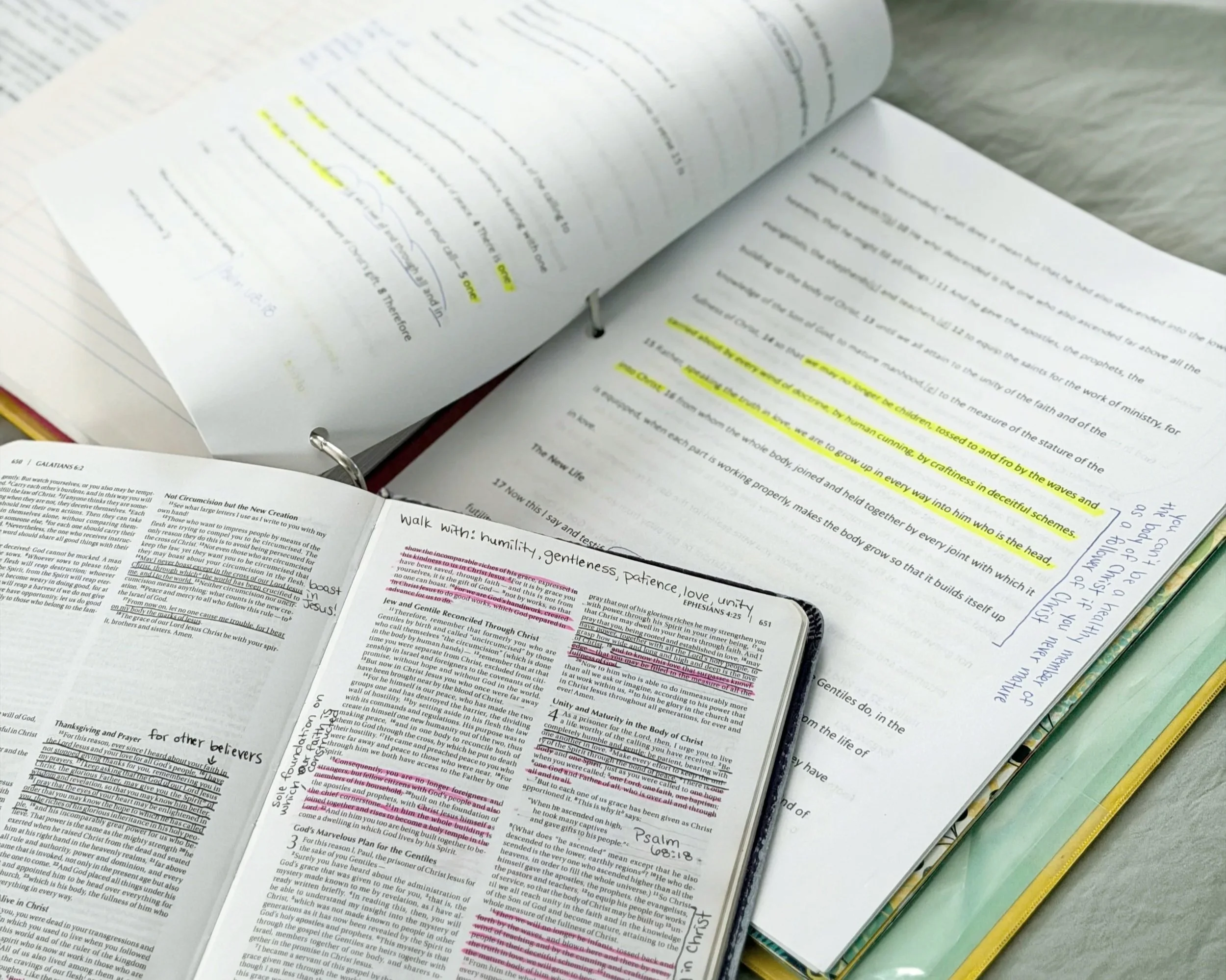
Studying the Bible doesn’t have to be difficult. It also doesn’t have to be instagram worthy, with the perfect lighting and multiple highlighters next to a steaming hot cup of coffee.
Don’t get me wrong, if you like studying that way…go for it. I’m not going to yuck on your yum.
But, if you’ve ever felt guilty that your quiet time doesn’t look like that I want to give you the freedom to know that it’s ok. My personal study time doesn’t happen at 5am, it happens more often than not at 10pm after my entire house has gone to sleep.
I’m a night owl, so when the rest of my family is asleep is when I do my best thinking. It’s when I wrote my book, Miracles in the Quiet, it’s when I formatted the entire Bible in a wide margin, double spaced format, and it’s also when I do most of my personal Bible study.
Regardless of when your quiet time happens, I want to share with you the steps I take in my own personal study time. Bear in mind, while I say steps I don’t necessarily do all these in order…you don’t want your study time to be a checklist. But, if you are just starting out in studying the Bible I highly recommend reading the book, Women of the Word by Jen Wilkin because it changed how I study scripture for the better.
Five P’s of Sound Study
Based off of Jen Wilkin’s Women of the Word: How to Study the Bible with both our hearts and our minds
Supplies you should have before you start:
A printed copy of the text, double-space with wide margins. Include footnotes and cross-references if possible (you can find them in resources section)
A pen and a highlighter
Optional: colored pencils/pens
Study with Purpose
Where does your text fit into the metanarrative of creation-fall-redemption-restoration?
Study with Perspective
What is the historical and cultural context?
Study with Patience
Don’t hurry yourself, be realistic with your pace of study
Study with Process
Study for comprehension, interpretation, and application
Study with Prayer
Ask the Father to help you before, during, and after your study time
Pray- Praise, Admit, Request, Thank
Read your text once (at least)
Answer- Where does this fit in the metanarrative? Is it telling about creation, fall, redemption, or restoration?
Answer the archaeological questions to find historical/cultural context (look for this information in a study Bible or trusted commentary)
Who wrote it?
When was it written?
To whom was it written?
In what style was it written?
Historical narrative (factual retelling of events)
parables/storytelling (crafted characters/settings to teach a lesson)
Law (uses language referring to situations or relationships)
Poetry (uses language symbolically and metaphorically to paint word pictures)
Wisdom literature (communicate principles that are generally true, thought not universally true)
Prophecy (uses language in symbolic ways)
Why was it written?
Read your text again- Give yourself patience (it’s ok if it takes you a month to understand one sentence, and it’s also ok if you only have 5 minutes of study today)
Pray- Praise, Admit, Request, Thank
Comprehension
Make an outline of your text
Annotate anything you think is important
Repeated words/phrases/ideas
Attributes of God
Are there several points in a row? Number them
Mark words you don’t understand or one you do know but want clarification, look them up in a dictionary & write it down on your copy
Key transition words (if/then, therefore, likewise, but, because, in the same way); draw an arrow to the beginning/concluding thought
Write down questions to address later
Interpretation
Look up cross-references (let scripture interpret scripture)
Paraphrase your text (write in your own words what you read)
Consult trusted commentary
Application
What does this passage teach me about God?
How does this aspect of God’s character change my view of self?
What should I do in response?
Pray- Praise, Admit, Request, Thank